
The Golden Nugget: Your tea bags are losing flavor every single day if they’re sitting in that cardboard box on your counter. The single most important thing you can do right now is move them into an airtight container away from light. Do this today, and your tea will taste garden-fresh for 2 to 3 years instead of going stale in 6 months.
Most people treat tea bags like they’re indestructible. You buy a box, toss it in the pantry next to the cereal, and assume those little paper pouches will taste the same whether you drink them next week or next year. But here’s what’s actually happening: every time you open that box, every hour that sunlight hits the packaging, every degree of heat in your kitchen, you’re watching hundreds of delicate flavor molecules break apart and disappear into the air.
This isn’t about being precious or obsessive. It’s about understanding that tea leaves, even inside those convenient little bags, are incredibly fragile. They’re dried plant matter packed with oils, antioxidants, and aromatic compounds that want to escape, oxidize, or transform the moment they’re exposed to the wrong conditions. The difference between tea stored properly and tea stored carelessly isn’t subtle. It’s the difference between a bright, complex cup that makes you close your eyes and savor it, versus a flat, papery liquid that tastes like hot water with a vague memory of plants.
Let me show you exactly how to protect your tea so it stays as vibrant as the day it was packaged.
What’s Actually Happening Inside Your Tea Bags Right Now
Think of a tea bag as a tiny treasure chest filled with incredibly delicate jewels. Each tea leaf fragment contains thousands of volatile compounds: essential oils that give you that bergamot punch in Earl Grey, polyphenols that create the briskness in black tea, amino acids like L-theanine that make green tea feel calming. These compounds are stable when the leaf is whole and living on the plant, but the moment those leaves are dried, cut, and packaged, they become vulnerable.
Your tea is under constant attack from four enemies: oxygen, light, heat, and moisture. Here’s what each one does to you.
When oxygen touches tea leaves, it triggers oxidation. This is the same chemical process that turns a sliced apple brown or makes cooking oil go rancid. The delicate essential oils in your tea, like the ones that create that floral note in jasmine tea or the malty sweetness in Assam, start breaking down into simpler, less interesting molecules. Picture a beautiful sculpture slowly crumbling into dust. That’s oxidation. After six months in a partially opened box, your tea has lost up to 40% of its aromatic compounds. You’re literally brewing a shadow of what that tea used to be.
Light, especially sunlight, accelerates this destruction. Ultraviolet rays provide energy that speeds up chemical reactions. It’s like turning up the heat under a pot: everything happens faster. Chlorophyll in green teas breaks down, turning your tea from a vibrant green to a sad, muddy brown. Catechins, the antioxidants everyone talks about, degrade. If your tea sits on a shelf where morning sun hits it, you’re aging it in dog years.
Heat makes molecules move faster. When your tea bags sit in a warm kitchen (anywhere above 70°F consistently), those flavor molecules become more active, more likely to evaporate or react with oxygen. Think of it like leaving ice cream on the counter: the warmer it gets, the faster it melts and loses its structure. Tea stored at room temperature degrades twice as fast as tea stored in a cool, dark place.
Moisture is the silent killer. Tea leaves are hygroscopic, which means they absorb water from the air like a sponge. When tea absorbs moisture, two terrible things happen. First, the water allows enzymes (tiny biological machines still present in the dried leaves) to wake up and start breaking down flavor compounds. Second, moisture creates the perfect environment for mold. You might not see visible mold on tea bags for months, but microscopic spores can start growing and producing off-flavors and potentially harmful compounds long before you notice anything wrong.
Here’s the part most people don’t realize: tea bags are actually more vulnerable than loose-leaf tea. The leaves inside bags are cut into tiny pieces (called “fannings” or “dust” in the tea industry) to speed up brewing. But smaller pieces mean more surface area exposed to air, light, and moisture. It’s like comparing a whole apple to apple slices: the slices go bad much faster because more of the flesh is exposed. Your tea bags need extra protection because they’re already compromised.
The Storage Mistake That’s Destroying Your Tea (And What Stores Won’t Tell You)
Walk into any grocery store and look at how tea is sold. Cardboard boxes, often with a little cellophane window so you can see the pretty bags inside, stacked on shelves under bright fluorescent lights. The tea industry has convinced you this is fine, that those flimsy boxes are adequate protection.
They’re not.
That cardboard box is porous. Air flows through it. Light penetrates it. If you live in a humid climate, moisture seeps through it. The box is designed for one purpose: to look attractive on a shelf so you’ll buy it. Once you bring it home, keeping your tea in that box is like storing your cash in a paper bag with holes in it.
The second massive mistake people make is storing tea in the kitchen. Your kitchen is the worst possible place for tea. Think about what happens in a kitchen: you boil water, you cook food, you run the dishwasher. All of this creates heat and humidity. Every time you brew a cup of tea, you’re releasing steam into the air. That steam condenses on cool surfaces, including the inside of your tea storage if it’s not properly sealed. You’re essentially creating a tropical environment for your tea, and tea does not want to be in the tropics after it’s been dried.
Here’s the myth the industry perpetuates: “Tea bags are convenient because you can just grab and go.” This convenience marketing makes you think tea bags should sit on your counter in an easy-to-reach container, maybe in a cute decorative box that matches your kitchen aesthetic. But every second those bags spend exposed to kitchen conditions, they’re degrading.
Cold brew tea drinkers make this mistake too. Many people assume cold-brewing is gentler and that tea bags used for cold brew don’t need special storage since they’ll eventually be steeped in cold water anyway. Wrong. The storage degradation happens before brewing. Your cold brew will taste dull and flat if the tea bags you’re using have been sitting in poor conditions, regardless of your brewing temperature.
The truth is simple: proper storage isn’t complicated or expensive, but it’s completely different from how the tea industry presents its product to you.
The Real Cost of Bad Storage (And How Much Money You’re Wasting)
Let’s talk numbers because this is where storage habits hit your wallet.
A box of 20 premium tea bags costs between $5 and $12 depending on the brand and type. That’s roughly $0.25 to $0.60 per cup. If you store those bags properly, they’ll maintain their full flavor for 24 to 36 months. If you store them in that cardboard box on your kitchen counter, they’ll start noticeably degrading in 3 to 6 months.
Here’s the math: You buy a box of expensive English Breakfast, 100 bags for $25. You drink tea twice a week. At that rate, the box should last you almost a year. But by month six, stored improperly, those bags have lost so much flavor that you start using two bags per cup to get the strength you want. Suddenly your 100-bag box only gives you 50 cups. You’ve just doubled your cost per cup from $0.25 to $0.50.
Or you do what most people do: you stop drinking the stale tea, feel guilty about wasting it, and eventually throw out 40 or 50 bags that taste like musty paper. You’ve literally tossed $10 to $12 in the trash.
Now multiply that across all the varieties you keep on hand. If you’re like most tea drinkers, you have 4 to 6 different types in your pantry: a black tea for mornings, a green tea for afternoons, maybe a chamomile for evening, a peppermint for digestion. Poor storage means you’re wasting $40 to $60 worth of tea every year.
Proper storage containers cost between $8 and $25 for a set of three to four airtight tins. You spend that once and you eliminate waste for years. The return on investment happens in the first 6 months.
But the real cost isn’t just money. It’s the experience. You chose a specific tea because you loved how it tasted in the store or at a friend’s house or on vacation. You want that experience every time you brew a cup. When your tea goes stale, you lose that. You start settling for mediocre cups. You might even decide you don’t like tea that much after all, never realizing the problem wasn’t the tea itself but how you stored it.
The value metric is this: proper storage costs you about $0.02 per cup over three years, but it preserves 100% of your tea’s value instead of watching 30% to 50% of it evaporate.
The Expert’s System for Keeping Every Tea Bag Perfect
Here’s exactly what I do, refined over years of testing different methods, and what professional tea buyers and blenders recommend.
Step 1: The Transfer (Do This the Day You Buy Tea)
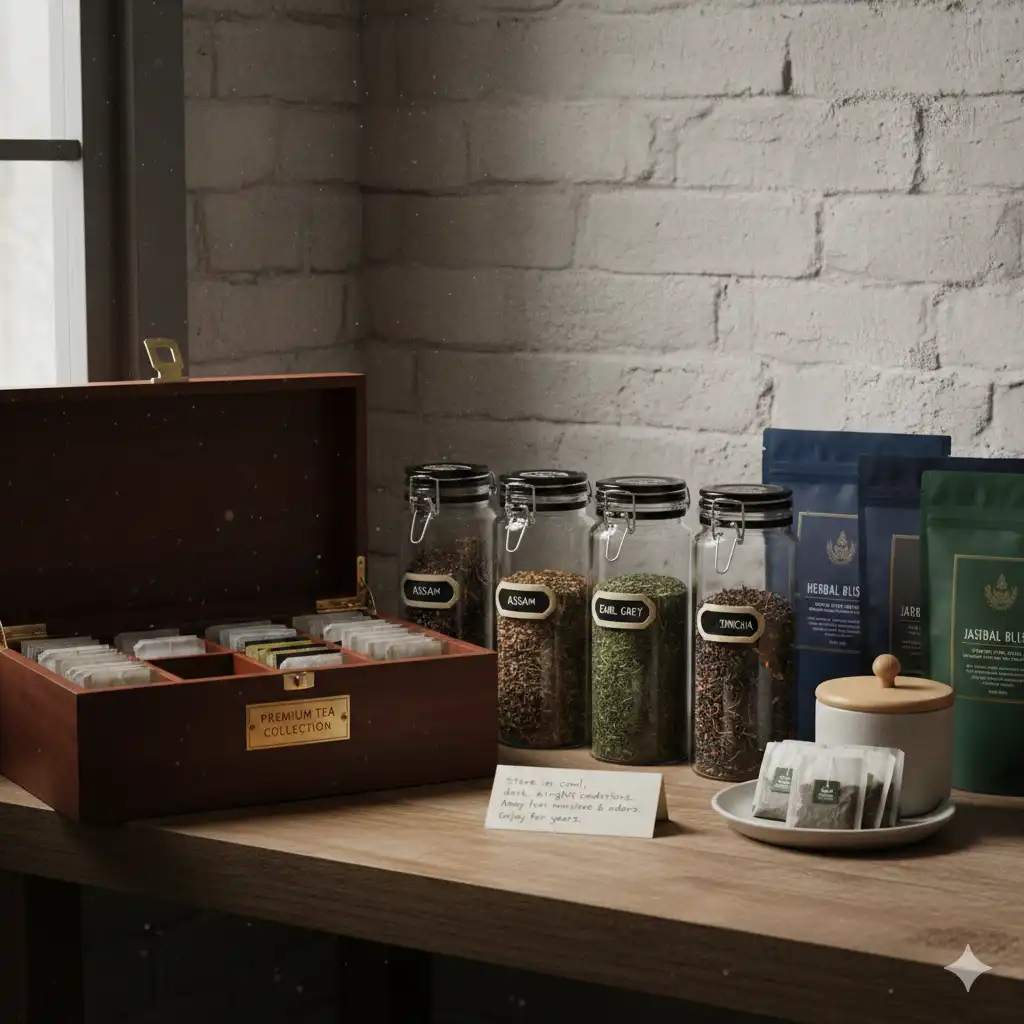
The moment you get home from the store, remove the tea bags from their cardboard box. Don’t leave them in there “just for a few days.” Every day counts. Get an airtight container. The best options are metal tins with silicone-sealed lids, dark glass jars with clamp lids, or food-grade plastic containers with locking mechanisms. The container must block light completely and seal tightly enough that you feel resistance when you open it.
Drop all the tea bags from one variety into one container. Keep different types separate. Never mix Earl Grey with chamomile in the same container; the flavors will cross-contaminate. If the tea bags came in individual foil wrappers (common with premium brands), you can leave them wrapped. If they’re loose paper bags, that’s fine too. The outer container is doing the real protection.
Step 2: The Label (This Prevents Future Confusion)
Write the tea type and the date you transferred it on a piece of masking tape or a label. Stick it on the container. In six months, you won’t remember if that tin contains Darjeeling or Ceylon, and you definitely won’t remember when you bought it. The date helps you track freshness, especially if you’re someone who buys tea in bulk or receives it as gifts.
Step 3: The Location (This Is Where Most People Fail)
Find the coolest, darkest, driest spot in your home that isn’t your refrigerator. The ideal storage temperature is between 55°F and 65°F with humidity below 50%. For most people, this means a cupboard or pantry far from the stove, dishwasher, and any windows. The back of a closet works. A drawer in a sideboard in your dining room works. Even a shelf in your bedroom closet is better than your kitchen counter.
Never store tea in the refrigerator or freezer. The temperature is right, but the humidity is wrong. Every time you take the container out, condensation forms on the cold surface. That moisture gets absorbed by your tea. You’re trading one storage enemy for another.
Step 4: The Ritual (Protect Your Tea Every Time You Use It)
When you want a cup of tea, take your container to wherever you’re going to brew, open it quickly, remove one bag, and seal it immediately. Don’t leave the container open on the counter while you boil water. Don’t let steam from your kettle waft into the container. Those 2 to 3 minutes of exposure add up over dozens of uses.
If you drink tea daily and want even easier access, use a two-container system. Keep a small airtight container (enough for one week’s worth of tea bags) in a convenient spot, and refill it weekly from your main storage container that lives in the ideal location. This minimizes how often you expose your entire supply to air and light.
Step 5: The Special Cases (Green Tea and Herbal Teas Need Different Care)
Green tea is more delicate than black tea. The chlorophyll and catechins break down faster. If you’re storing green tea bags, consider adding a food-grade silica gel packet (the little packets that come in vitamin bottles or shoe boxes) to your container to absorb any trace moisture. Replace the packet every 3 months.
Herbal teas, especially those with flowers or fruit pieces, are prone to losing color and aroma quickly. Store these in the darkest containers you have and check them every 6 months. If you notice the color fading or the scent weakening, those are signs it’s time to use them up or replace them.
Advanced Move: The Vacuum Seal
If you buy tea in large quantities or you want to store tea for longer than 2 years, invest in a vacuum sealer. You can vacuum-seal groups of tea bags in small batches (10 to 20 bags per pouch), then store those pouches in a larger container for double protection. This removes almost all oxygen and creates a nearly perfect environment. Professional tea companies use nitrogen flushing for the same reason: eliminate oxygen, stop degradation.
How Tea Storage Is Changing in 2026
The tea industry is finally catching up to what coffee did a decade ago: realizing that packaging matters as much as the product inside.
Several premium brands now sell tea in nitrogen-flushed, resealable foil pouches instead of cardboard boxes. These pouches have a one-way valve that lets residual gases escape without letting oxygen in, similar to high-end coffee bags. If you see tea packaged this way, it’s worth paying the extra dollar or two because you’re getting better baseline protection.
Smart storage is emerging too. There are now airtight containers with built-in humidity sensors that connect to your phone and alert you if conditions inside the container drift out of the ideal range. These are overkill for most people, but if you’re serious about tea or you’re storing rare, expensive varieties, they’re becoming affordable (under $40 for a good one).
The biggest shift is consumer awareness. More tea drinkers are starting to treat tea the way wine enthusiasts treat wine: understanding that storage affects quality. Online communities and tea subscription services are educating people about proper storage, and that’s pushing the industry to improve packaging standards.
We’re also seeing a rise in compostable, airtight containers made from plant-based materials. These solve the sustainability problem without sacrificing protection. In the next few years, expect to see more tea sold in containers you can actually keep using for storage instead of immediately transferring to something else.
Your Questions Answered (The Ones You’re Actually Wondering About)
Can I store different types of tea bags in the same container if I’m short on space?
Only if they’re very similar in flavor profile. You can store two different black teas together without much cross-contamination. But never mix strongly scented teas (like Earl Grey or chai) with delicate ones (like white tea or green tea). The essential oils from the stronger tea will migrate and flavor the milder one. If you must share a container, keep each type in its own sealed plastic bag inside the larger container for a barrier.
Will storing tea bags in the freezer make them last forever?
No, and it can actually ruin them. Freezers are too humid. When you take frozen tea bags out, they warm up and condensation forms. That moisture gets absorbed into the tea. If you absolutely must freeze tea (maybe you inherited a massive quantity), vacuum-seal it first in completely airtight packaging, and when you remove it, let it come to room temperature before opening the seal. For normal household quantities, a cool, dark cupboard is far better.
How can I tell if my tea bags have gone bad?
Brew a cup and smell it before you taste it. Fresh tea has a bright, distinct aroma. Stale tea smells flat, dusty, or even slightly musty. If you taste it and it’s bitter, astringent, or has no flavor at all despite steeping for the right amount of time, your tea has degraded. Visually, look for any discoloration on the bags themselves or any spots that might indicate mold. If you see anything fuzzy or dark spots that weren’t there originally, throw it out.
Is it worth buying those expensive tea storage tins, or will any airtight container work?
Any truly airtight container works. The expensive decorative tins are nice if you want them on display, but a $3 food storage container with a good rubber seal will protect your tea just as well as a $25 Japanese tea caddy. What matters is the seal and whether the material blocks light. Opaque is better than clear. Metal and dark ceramic are better than clear glass or plastic.
Do tea bags expire even if stored perfectly?
They don’t spoil in the sense that they’ll make you sick, but they do lose quality over time. Black tea stored perfectly will taste great for 2 to 3 years, then slowly fade. Green tea is best within 12 to 18 months even with perfect storage. Herbal teas vary: peppermint and chamomile hold up well for 2 years, but fruity or floral blends lose their brightness faster. The “best by” date on the box is usually conservative; properly stored tea often tastes good well beyond that date.
What if I’ve already been storing my tea badly for months? Can I save it?
Transfer it to proper storage immediately. You can’t reverse the damage that’s already happened, but you can stop further degradation. Brew a cup and honestly assess the flavor. If it’s already noticeably stale, you might want to use it for iced tea or blending (mixing it with fresher tea can help mask the flatness). Going forward, everything you buy gets stored right from day one.
Should I keep tea bags in their individual paper envelopes or remove them?
If the tea came in individual sealed foil or plastic pouches, leave them in there and store the whole collection in your airtight container. That double layer of protection is excellent. If they’re just loose tea bags or in thin paper envelopes, it doesn’t make much difference; the outer airtight container is doing the heavy lifting. The one exception: if the paper envelopes have a strong scent (some do), and you’re storing multiple varieties together, the scent might transfer. In that case, keep them in their envelopes for separation.







Leave a comment